Artificial Intelligence & Intelligent Business Processes

AI Project Feasibility | Artificial Intelligence & Intelligent Business Processes

Before you invest, we assess technical suitability, data readiness and expected benefit using measurable criteria.

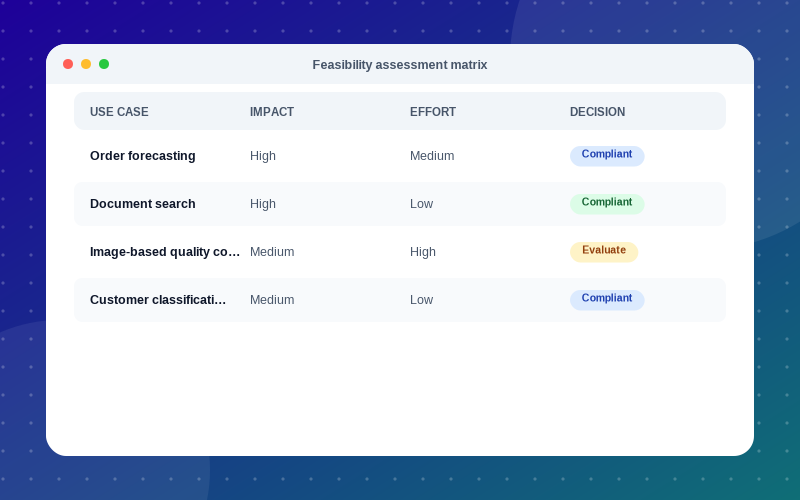
AI Project Feasibility – image 1
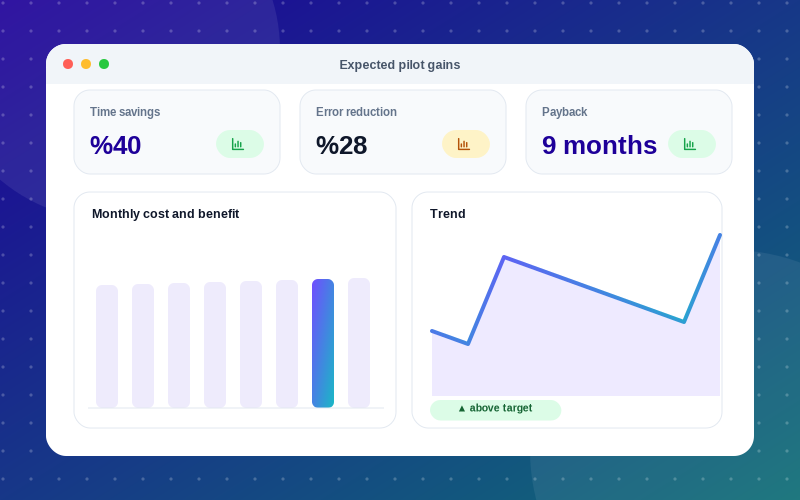
AI Project Feasibility – image 2

Before you commit budget to an artificial intelligence project, we assess technical suitability, data adequacy and expected benefit against measurable criteria. Deliverables are a feasibility report, a decision recommendation and, where appropriate, a pilot scope definition.

From idea to decision: why a feasibility study matters

Many artificial intelligence initiatives stall not because of the technology but because of insufficient data, unclear goals or unrealistic expectations. A feasibility study makes these risks visible before the project begins. We turn your idea into a concrete business question and assess honestly whether artificial intelligence is the right tool or whether an alternative solution would make more sense.

Data adequacy and technical suitability analysis

The success of a model depends heavily on data. We review existing data sources for volume, consistency, label quality, timeliness and accessibility, and list the gaps and the data that still needs to be collected. On the technical side we assess the required infrastructure, response-time expectations, security and personal-data constraints and integration points with existing systems.

Cost-benefit framework and pilot definition

We define the expected benefit in business-process terms: staff time spent, error or rework rate, decision delay and similar measures. These are weighed against development, operating, licence and maintenance costs. If the outcome is positive, we define a pilot with success criteria written down in advance and a limited scope, so that the investment decision rests on observation rather than assumption.

What is included?

  • Use-case clarification: We turn the idea into a business question with a defined input, output, user and decision point, and also consider alternatives that do not require artificial intelligence.
  • Data inventory: We list source systems, data volume, labelling status, quality issues and access restrictions, and recommend how any missing data could be obtained.
  • Approach and model selection: We compare off-the-shelf services, fine-tuning and custom development in terms of accuracy, cost, confidentiality and maintainability.
  • Risk and compliance assessment: We identify risks relating to personal data, copyright, security, erroneous output and human oversight, and document possible controls and responsibilities.
  • Pilot and roadmap: We prepare a plan for decision makers containing success criteria, pilot scope, team requirements and the stages of moving to production.

How we work

  1. Discovery

    We meet with executives and process owners to establish the goal, the current way of working and today's measurable indicators (time, errors, volume), and reduce the idea to a one-sentence business question.

  2. Planning

    We take real data samples, run them through quality and coverage checks and, with a small experiment, collect initial evidence of the level of accuracy the approach can achieve.

  3. Implementation

    We collect technical options, cost items and risks in a comparison table and evaluate them by scenario, clearly marking our assumptions and the points that remain uncertain.

  4. Support

    We present the findings in a feasibility report and justify our go or no-go recommendation; if positive, we jointly finalise the pilot's scope, schedule, criteria and the resources needed for the next stage.

What you gain

You take the investment decision on findings based on data and experiment rather than assumptions, and the risk of funding an unsuitable project becomes visible in advance.

Data gaps as well as security and compliance risks are listed early, which reduces unexpected costs and delays that could otherwise emerge once the project has begun.

Management, IT and business units agree on the same success criteria, so that at the end of the pilot there is a clear basis for deciding whether to continue or stop the project.

Who is it for?

This service is for managers, entrepreneurs and project owners who have an idea involving artificial intelligence and want to validate it technically and financially. It is particularly suitable for projects with an unclear data landscape, a limited budget or an internal approval process. It targets teams that want an impartial, reasoned assessment before they decide.

Frequently Asked Questions

Are we obliged to start the project after the feasibility study?

No. The purpose of the study is to help you decide; the result may be negative or conditional, and we report that openly. You can use the report to proceed with your own team, with another supplier or with us. Implementation is planned as a separate scope.

We think we do not have enough data; can we still apply for this service?

Yes, and this is in fact the most valuable part of the study. We assess how much of the available data is usable, which data would need to be collected and, where data is scarce, whether pre-trained models or rule-based methods could be sufficient.

Related services and resources

Quote & demo

Let's evaluate your project together.

Let's start with a short call about QISO demo, ISO consulting, Artificial intelligence feasibility or your custom software needs.

  • QISO demo
  • ISO consulting
  • Artificial intelligence
  • Custom Software