Integration Services

Database Integrations | Integration Services

We create data transfer and synchronization solutions between different databases.

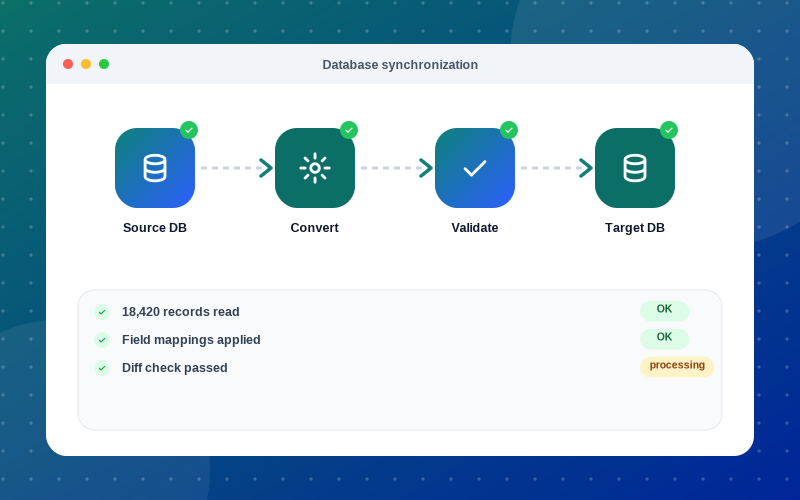
Database Integrations – image 1
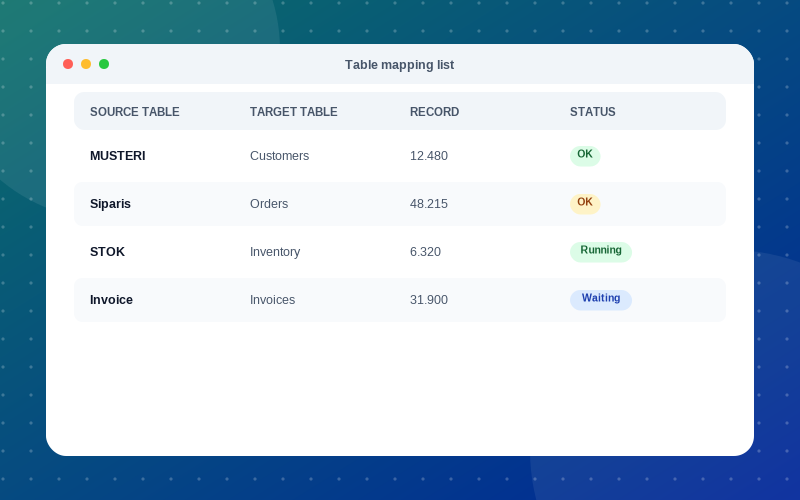
Database Integrations – image 2

We build scheduled or event-driven data transfer and synchronisation between different databases such as SQL Server, Oracle, PostgreSQL and MySQL, delivering a working data flow with transformation rules, validation steps and reconciliation reports.

Choosing the right transfer model

Not every data flow is solved the same way. A nightly batch ETL job may be enough for reporting, while moving data such as stock or orders calls for change data capture or a trigger-based approach. We weigh data volume, latency tolerance and load on the source system together, and recommend, with reasons, the batch, incremental or event-driven model that suits you.

Transformation, validation and data quality

Source and target databases usually differ in data types, character sets and key structures. We put the mapping rules in writing and define type conversions, null handling and duplicate behaviour explicitly. Records that break the rules are routed to a separate error table during transfer, so a single faulty row does not halt the entire load and the problem can be fixed at its source.

Performance and impact on the source system

Reading from a live production database can slow the application if poorly designed. We schedule reads outside peak hours, review indexes and query plans and, where needed, use a readable replica or staging table. For bulk writes we tune batch size and measure transaction-log impact, with the aim that the integration runs without users noticing it.

What is included?

  • Source and target analysis: Table structures, keys, data volume and change frequency are surveyed, and it is determined which fields move in which direction.
  • Transfer mechanism: Scheduled jobs, change data capture or trigger-based event transfer are selected and implemented.
  • Transformation rules: Type, encoding, unit and key mappings are tied to written rules, and null and duplicate behaviour is defined.
  • Validation and reconciliation: Record counts, totals and checksums are compared, and faulty rows are reported in a separate table.
  • Performance and operation: Batch size, indexing and timing are tuned, and job history, duration and error indicators are monitored.

How we work

  1. Discovery

    Inventory and goals: We list the databases to be integrated, their versions, access rights and the business purpose of each transfer, and agree with you which system counts as the authoritative source.

  2. Planning

    Data model and mapping design: We document table and field mappings, transformation rules and the conflict-resolution strategy, and run a prototype transfer with sample data to test assumptions on real records.

  3. Implementation

    Development and initial load: We code the transfer jobs, perform the initial load of historical data in controlled batches, and verify through record-count and total checks that source and target match exactly.

  4. Support

    Go-live and operation: We activate the schedules, set up alerts and a rerun procedure for failed jobs, hand over the data dictionary and operating notes, and reconcile differences daily in the early period.

What you gain

Data is updated in one place and flows automatically to the other systems, reducing the need for manual transfers and Excel merging.

Reconciliation reports based on record counts and totals make it possible to demonstrate, run after run, that the two systems are consistent.

Because read and write load is kept under control, your production applications keep responding while the integration runs.

Who is it for?

This service suits businesses whose departments each run separate databases and who want to consolidate data for reporting, organisations that must migrate historical data when moving from an old system to a new one, and IT teams that need ERP, quality or production applications to stay in sync at database level. Where data ownership is unclear, we first establish the rules together.

Frequently Asked Questions

Can you transfer between different database engines?

Yes. Between common engines such as SQL Server, Oracle, PostgreSQL and MySQL we resolve differences in data types, character sets and date formats through mapping rules. Our main experience lies in Microsoft environments; if another engine is involved, we confirm version and driver compatibility during discovery and tell you about possible limitations up front.

Is data lost if an error occurs during the transfer?

By design, no. Writes are performed with transactional integrity; when an error occurs the affected batch is rolled back and can be rerun. Records that break rules go to an error table, and the source data is left untouched. Because record counts and totals are compared on every run, a missing or surplus transfer is noticed and reported.

Related services and resources

Quote & demo

Let's evaluate your project together.

Let's start with a short call about QISO demo, ISO consulting, Artificial intelligence feasibility or your custom software needs.

  • QISO demo
  • ISO consulting
  • Artificial intelligence
  • Custom Software